Graduating with M.S. in Behavioral and Computational Economics: A Journey Through Experimental Economics
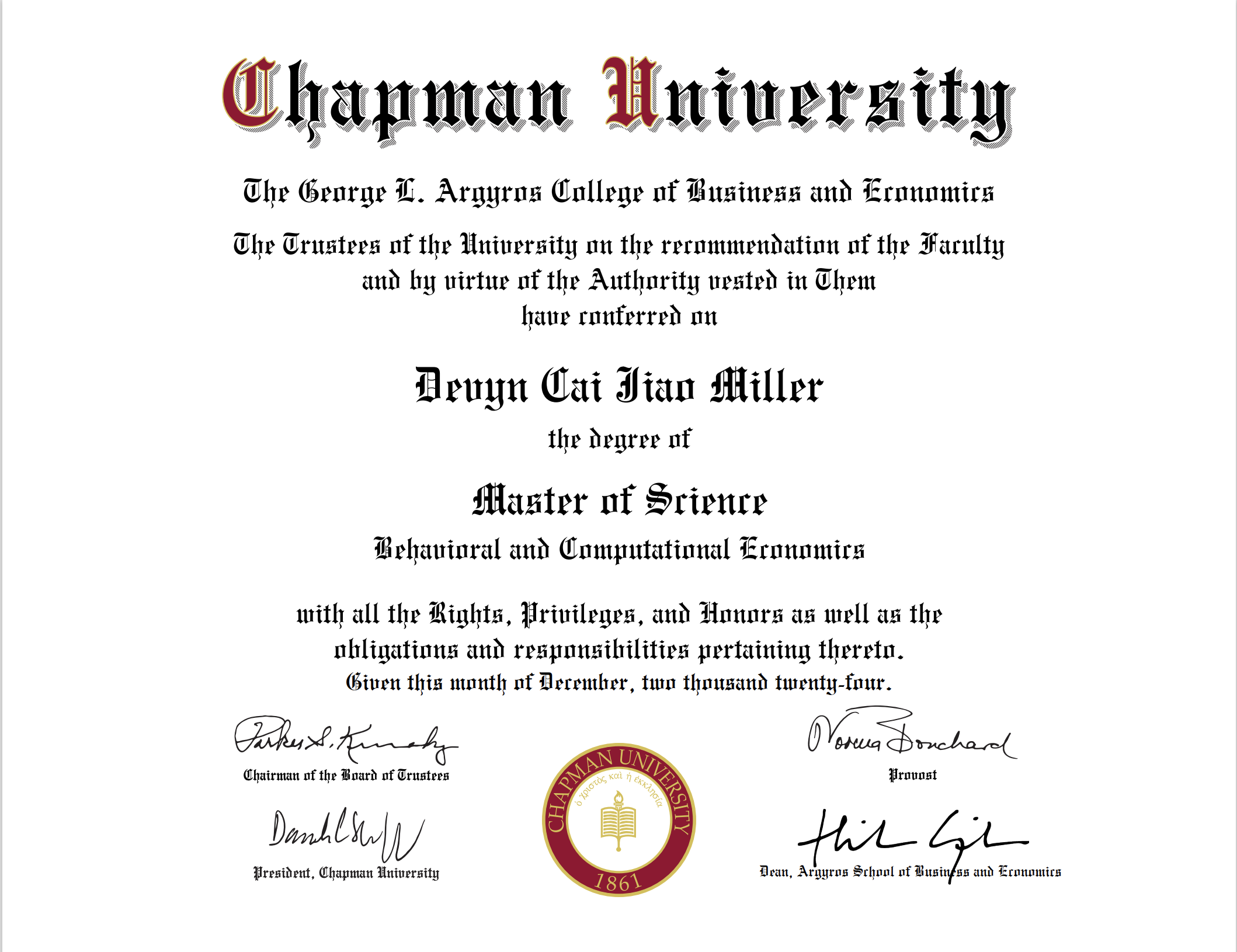
Graduating with M.S. in Behavioral and Computational Economics: A Journey Through Experimental Economics
As I complete my Master of Science in Behavioral and Computational Economics (M.S. BCE) at Chapman University's Argyros School of Business and Economics this December 2024, I find myself reflecting on an extraordinary academic journey that has bridged the worlds of behavioral economics, computational methods, and experimental research.
The Economic Science Institute Legacy
I have truly enjoyed being part of Chapman's Economic Science Institute, inspired and developed by Vernon L. Smith. Smith's innovative approach to economics education earned him the 2002 Nobel Prize in Economic Sciences and has shaped my understanding of economic principles through hands-on experimentation and research.
Academic Journey Highlights
Throughout my master's program, I've had the privilege of exploring a range of subjects that combine traditional economic theory with cutting-edge computational methods:
Core Economic Theory and Behavior
- Behavioral Economics & Finance: Explored the psychological underpinnings of economic decision-making
- Game Theory I & II: Mastered the mathematical foundations of strategic interaction
- Economic Systems Design: Studied mechanism design and market systems
- Auction and Market Design: Analyzed efficiency and fairness in market mechanisms
- Bayesian Statistics: Applied probabilistic reasoning to economic problems
Computational and Technical Skills
- Computational Economics I & II: Developed advanced modeling techniques
- Deep Learning & Computer Vision: Applied AI to economic analysis
- Database System Implementation: Built robust data management systems
- Statistical Machine Learning: Mastered predictive modeling techniques
Research and Professional Development
- International Research Incubator: Engaged in cross-cultural research projects
- Individual Study: Conducted independent research under faculty guidance
Research and Practical Applications
As an ML Researcher at the Economic Science Institute, I've had the opportunity to:
- Participate in experimental economics research
- Apply computational methods to analyze market behaviors
- Collaborate with distinguished faculty members
- Contribute to ongoing research in behavioral economics
The ESI Approach to Learning
In my final term as a Business Economics undergraduate student at UC San Diego, I began looking into grad school. Through much research comparing various graduate programs, I learned how most of them focus solely on the abstract theories of economics. However, Chapman really appealed to me because of how it integrates experimental economics into the learning experience. Campus is also only 15 minutes from my house! I am so glad that I chose to go with Chapman's M.S. BCE program. As an ESI student, I've been a part of conducting hands-on experiments in real-world settings. This approach allows us to:
- Observe economic principles in action
- Test theoretical predictions against actual behavior
- Develop intuitive understanding beyond formal theory
- Question and analyze unexpected outcomes
Looking Forward
Earning this degree has been more than just academic achievement. Through my time in the program, I've grown my passion and curiosity for applying experimental and computational methods to real-world challenges. I have been immersed in a special world of economics, where behavioral insights, computational tools, and experimental methods work together to provide a unique perspective on economic problem-solving.
I look forward to applying what I've learned in this program in future endeavors, continuing the legacy of innovative economic research that Chapman University and the Economic Science Institute represent!
— Devyn
Related Posts
A Commencement Week Reflection
Reflections on a week of celebration, transitions, and personal growth during my graduation week.
Navigating the Tech Job Market as a New Grad
The realities of job hunting as a new graduate in the tech industry during 2025, including how to stay motivated and be strategic.
Building My Personal Portfolio Website
The creation of my personal portfolio website, technologies used, and personal growth that came with building a digital home :)